
Workshops, seminars, and collaborative programs organised by QMD Foundation
Previous Event
QMD Foundation has successfully supported and organized several events, workshops, and discussions focused on advancing research in quantum materials and device technologies, bringing together researchers, students, and industry experts for knowledge exchange and collaboration.
PRAGYA-QMD 2026
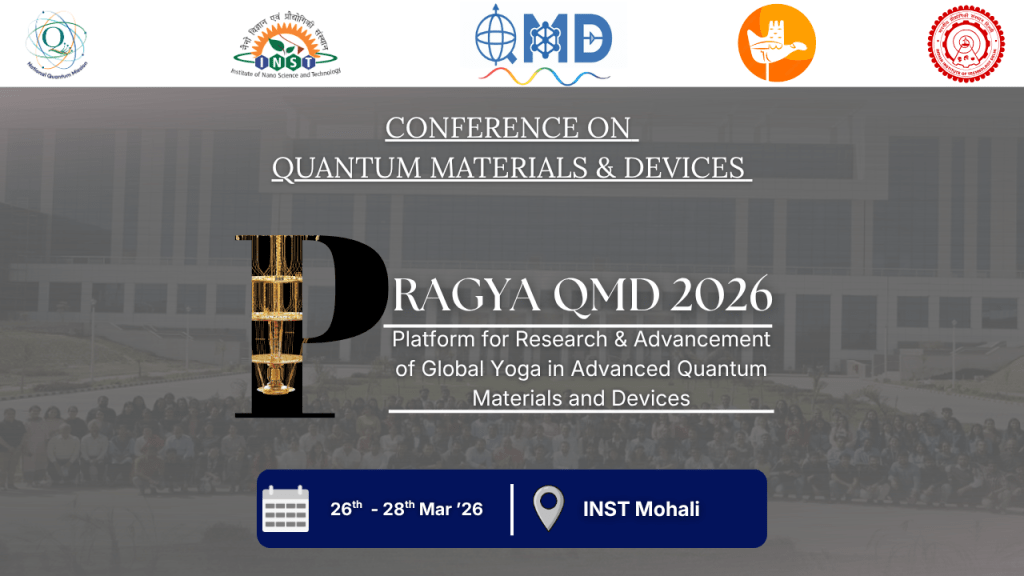
PRAGYA-QMD 2026 (Platform for Research Advancement of Global Yoga in Advanced Quantum Materials and Devices) is an international conference focused on the latest developments in quantum materials, quantum devices, and enabling technologies for next-generation quantum systems. The conference aims to create a collaborative platform where scientists, academicians, industry experts, and young researchers can exchange ideas, present cutting-edge research, and explore emerging opportunities in the rapidly evolving field of quantum science. The event will feature plenary talks, invited lectures, technical sessions, and poster presentations covering key areas such as quantum materials, photonic systems, superconducting technologies, semiconductor quantum devices, and other innovations that support quantum computing, quantum communication, and quantum sensing.
PRAGYA-QMD also aligns with India’s National Quantum Mission (NQM) by promoting interdisciplinary research and strengthening collaborations between leading institutes, laboratories, and industry partners working in quantum technologies. By bringing together experts from across the globe, theconference aims to accelerate progress in fundamental research as well as practical quantum technology development, contributing to the future of advanced computing, secure communication, and precision sensing.
PRAGYA-QMD 2026 (Platform for Research Advancement of Global Yoga in Advanced Quantum Materials and Devices) is an international conference focused on the latest developments in quantum materials, quantum devices, and enabling technologies for next-generation quantum systems.
The conference aims to create a collaborative platform where scientists, academicians, industry experts, and young researchers can exchange ideas, present cutting-edge research, and explore emerging opportunities in the rapidly evolving field of quantum science.
The event will feature plenary talks, invited lectures, technical sessions, and poster presentations covering key areas such as quantum materials, photonic systems, superconducting technologies, semiconductor quantum devices, and other innovations that support quantum computing, quantum communication, and quantum sensing.
PRAGYA-QMD also aligns with India’s National Quantum Mission (NQM) by promoting interdisciplinary research and strengthening collaborations between leading institutes, laboratories, and industry partners working in quantum technologies.
By bringing together experts from across the globe, theconference aims to accelerate progress in fundamental research as well as practical quantum technology development, contributing to the future of advanced computing, secure communication, and precision sensing.

Half-Day Seminar: Quantum Materials Growth Facility at IIT Delhi – Enabling Next-Generation Quantum Technologies

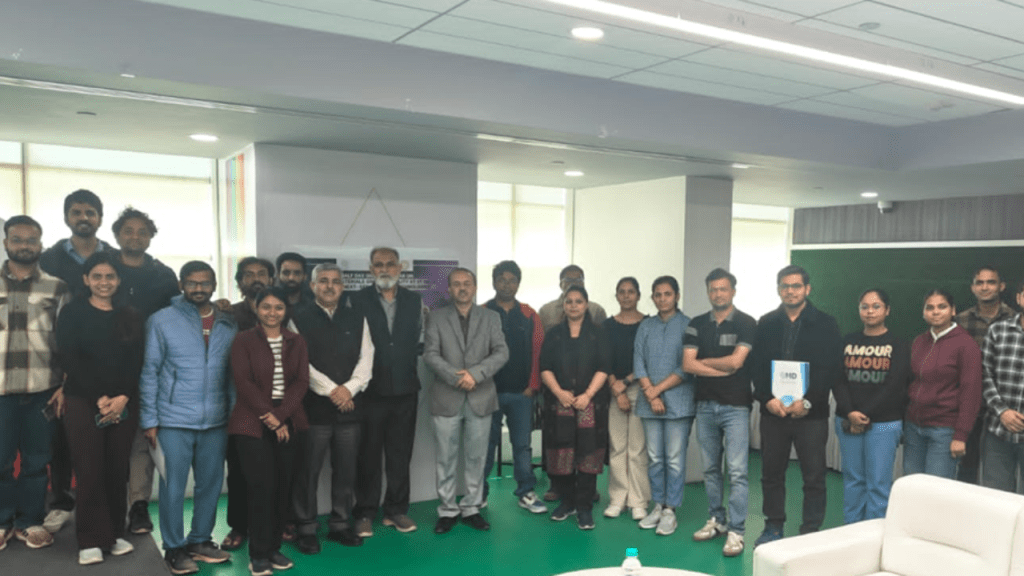
A half-day seminar titled “Quantum Materials Growth Facility at IIT Delhi – Enabling Next-Generation Quantum Technologies” was organized on 17 February 2026, Ideation lounge, R&I Park, IIT Delhi. The seminar brought together researchers and faculty members from various leading institutes across India working in the areas of quantum materials, device physics, and emerging quantum technologies. The objective of the event was to provide a platform for researchers to present their ongoing work, discuss their research requirements, and explore how the facilities under the Quantum Materials and Devices (QMD) Hub can support their material and device development needs. Approximately 40 participants physically attended the seminar, including faculty members, researchers, and technical staff and almost 20 participants attended online.
The seminar began with the inaugural remarks delivered by Prof. Rajendra Singh, Project Director, QMD Foundation and Prof. Samaresh Das, CARE, IIT Delhi. In their opening address, they welcomed the speakers and participants and briefly introduced the vision and objectives of the Quantum Materials and Devices (QMD) Hub. Prof. Singh spoke about the overall working and structure of the QMD Hub, highlighting its role in building a coordinated ecosystem for quantum materials and device research in India. He emphasized that centralized facilities for material growth, fabrication, and characterization can significantly accelerate research by providing access to high-quality materials and enabling collaboration among institutions. Prof. Das focused on the technical aspects of the QMD Hub, explaining the types of facilities, infrastructure, and technical capabilities being developed under the program. He also highlighted how these facilities can support researchers working on quantum materials, devices, and related technologies. Both speakers encouraged participants to share details of their ongoing research and to outline the material and facility requirements that could potentially be supported through the QMD Hub. Following the inaugural session, the first technical talk was delivered by Dr. Ashok Kapoor, QMD Foundation. In his presentation, he introduced the Molecular Beam Epitaxy (MBE) system at IIT Sonipat and discussed the material growth capabilities available at the facility. He highlighted the growth of two-dimensional (2D) materials with controlled technical specifications and explained their importance for developing advanced quantum and optoelectronic devices. The next presentation was delivered by Dr. Kamlesh Bhatt, who provided an overview of the Molecular Beam Epitaxy (MBE) facility at Sonipat campus of IIT Delhi. During the session, Dr. Bhatt connected via video call and gave a live virtual demonstration of the MBE system, explaining the hardware components and its operation in detail. He highlighted the facility’s capability for the growth of two-dimensional (2D) materials with controlled parameters and discussed how such materials can support research in advanced quantum and optoelectronic devices. The participants were also introduced to the key instrumentation and infrastructure available at the facility, which can support collaborative work under the QMD Hub.
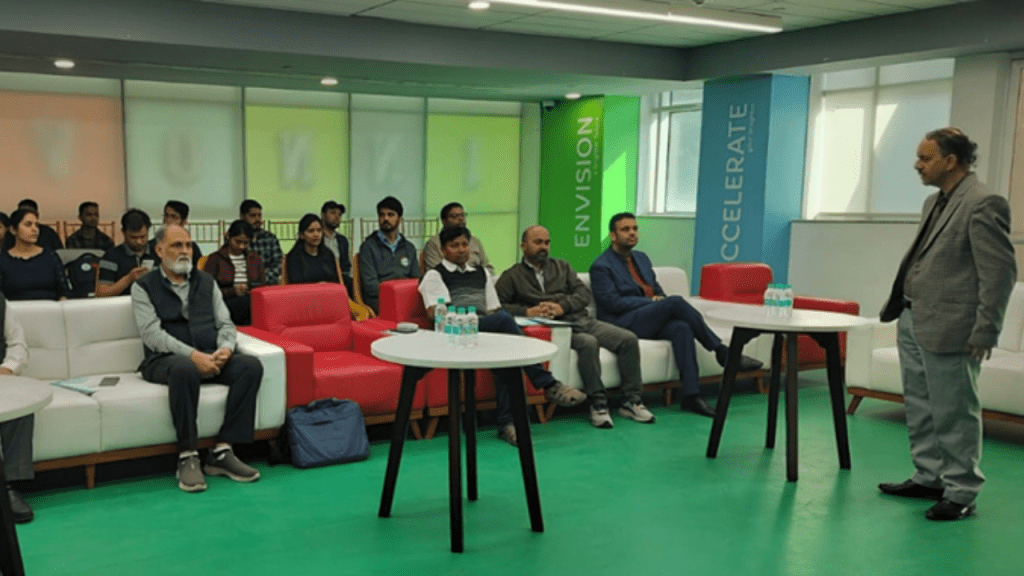
The session continued with a talk by Prof. Ashish Arora, IISER Pune, who briefly presented his research on the optical and spectroscopic studies of quantum materials. He also highlighted some of the instrumentation facilities in his laboratory, including a 2D layered material transfer system and other characterization tools used for studying layered materials and heterostructures.
A short tea break followed, during which participants interacted and discussed potential collaborations and material requirements from the QMD Hub, particularly related to 2D materials and heterostructures for quantum and photonic devices.
The second technical session began with a presentation by Prof. Prasanna K. Sahoo, IIT Kharagpur, who discussed his group’s work on the growth of two-dimensional (2D) materials. He highlighted the importance of controlled material synthesis and high-quality growth for studying fundamental properties and enabling device applications based on 2D materials. This was followed by a talk by Prof. Tanushree Choudhary, IIT Bombay who presented her research on two-dimensional (2D) materials for electronic and quantum device applications. She discussed the challenges involved in the synthesis and growth of high-quality 2D materials with controlled properties, which are essential for reliable device performance. She also emphasized the importance of scalable and reproducible growth techniques to enable practical device development. During her talk, Prof. Choudhary highlighted that advancements in 2D material-based devices require strong collaboration between materials scientists, physicists, and device engineers in order to translate fundamental research into functional quantum and electronic technologies. The final technical presentation was delivered by Prof. Rik Dey, IIT Kanpur. In his talk, he shared insights into his group’s research on nanomaterials and device platforms relevant to emerging quantum technologies. He highlighted how advanced material systems can play a key role in enabling next-generation computing, sensing, and communication technologies. Prof. Dey also discussed how facilities like those being developed under the QMD Hub could provide critical support to researchers by offering access to high-quality materials and advanced fabrication infrastructure.
The seminar concluded with closing remarks by Prof. Rajendra Singh, who summarized the key discussions and outcomes of the event. He thanked all the speakers and participants for their valuable contributions and emphasized the importance of continued collaboration among institutions working in the field of quantum materials and devices. During the concluding discussion, he also invited the speakers to share their specific material requirements that could potentially be provided by IIT Delhi under the QMD Hub, encouraging open dialogue on possible research support and collaborations. Prof. Singh highlighted that such interactions are important for identifying the material needs of different research groups and aligning the capabilities of the QMD Hub facilities accordingly. He also emphasized the role of collaborative efforts in accelerating research and development in quantum technologies. Overall, the seminar provided an effective platform for researchers to present their work, discuss material requirements and collaborative opportunities, and explore ways in which the QMD Hub and IIT Delhi facilities could support their research. The discussions highlighted the growing demand for high-quality quantum materials and advanced growth facilities, while also strengthening connections among researchers from different institutions working in this field.